Spoiler warning: this post includes a screenshot from a boss fight in Echoes of the Unread.
In 2016 I started a blog post called "Adventures in 6502 Assembly." It never got past the title. Ten years and one finished NES game later, here it is.
The story of Echoes of the Unread starts with a Super Mario Bros. graphics hack: a "coffee run" for my sister's milestone birthday. I've told that part elsewhere. This post is about everything around it: the prototypes, the tools, and what the NES taught me.
Not my first assembly
I'd written assembly before. I took it in college, and technically I'd played around with it on my TI-86 in high school. The instructions weren't the hard part. The hard part was learning the limits of the NES, and building up the tools I needed to work within them.
I tried a few other assemblers and toolchains before settling on cc65. It worked well with Makefiles and had a decent linker, which mattered more than I expected once a project grew past a single file. I wrote most of the game in C, dropping into 6502 assembly where I needed to. C made development slightly quicker, which is hilarious, given that it still took ten years to finish my game.
Zombie coworkers
You have to remember that I'd been making Flash games before this. One of them was a prototype about escaping an office and fighting off zombie coworkers with a Nerf gun. It had a flashlight, dark areas, a few different parts of the office, and Nerf darts to shoot. In my head it was the most impressive thing I'd made at the time. In reality, it probably wasn't much, and I've since lost the source code. (Apparently I've been making flashlight games for a while. Ten Thousand Floors has one too.)
My first NES prototype in 2016 was an attempt to bring that game to the NES. It never got further than a few sprites walking around the screen aimlessly.
Building the tools
The NES doesn't come with an editor, so I built my own pipeline in Python, and you can see it grow from project to project. The zombie prototype had a single script that converted images into NES tiles. By the time I started my next prototype, I had a converter for Tiled tilesets and maps, a CSV converter for game data, and scripts that turned levels into a format the NES could read quickly. Echoes later added a converter for dialogue scripts, so I could write the story in a text file instead of in code.
The tools did more than convert. They caught a lot of mistakes at build time, which saved me from stepping through 6502 in a debugger. That's one of the last things I want to do if I can help it.
Atomovac
By the time Atomovac came along in 2020, I had a pretty decent set of tools. The name is a play on "atomic vacuum," which a friend came up with. I thought it was good enough for a codename, and it stuck.
You were an astronaut on an alien planet, and the idea was that you could "suck up" different abilities and your gun would change, kind of like Kirby. Then the idea got really big. I was going to add a second character you could swap to: a space monkey companion that was faster and could get into smaller spaces, while the astronaut was slow and had the gun.
The real breakthrough was technical. Atomovac had doorways and scrolling in both directions. When I realized I could backport that to the library game, which was still called "Upon a Time" at that point, it completely changed the game. That engine is what Echoes is built on.
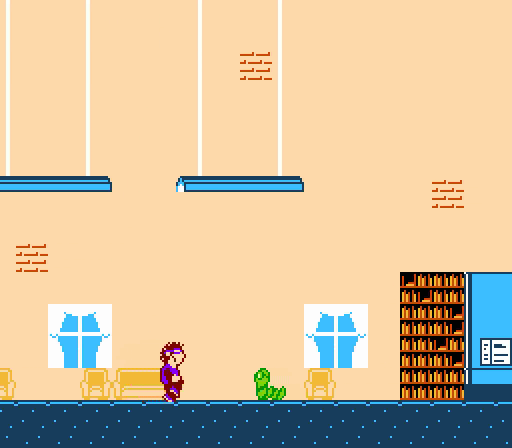
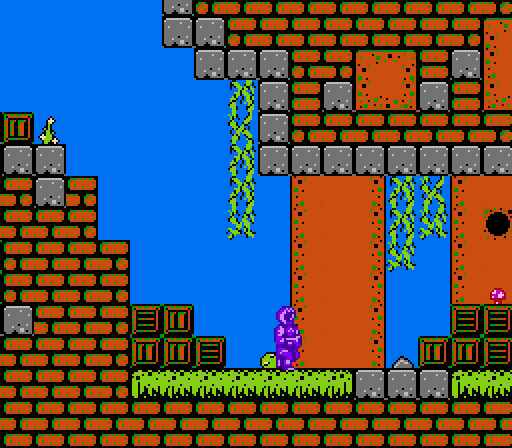
You can play the Atomovac prototype in your browser.
Living with the limits
One of the hardest constraints was the limited palette and number of tiles. On top of that, I was using UNROM at the time, so graphics live in RAM and have to be copied over during the short window between frames. Only a few tiles could change each frame, and that limited what the game could do.
UNROM also meant no save files, at least at first. I was prepared to build a password system before I realized I could switch to MMC1, the mapper Zelda used for its battery-backed saves.
Sprites were another constant fight. The NES can only draw eight sprites on a line, and anything past that just doesn't show up. The sci-fi boss fight has a large target that moves around, and it could make other enemies disappear. So I wrote a flicker routine that rotates all the sprites each frame, keeping the player fixed in the top slot so they never flicker, similar to how Mega Man does it. Things blink a little, but nothing vanishes.
Working around those limits makes for some great bugs. Here's the boss fight spoiler I warned you about.
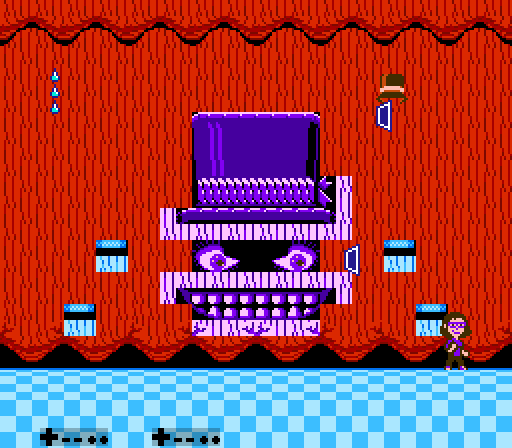
It was caused by the pause screen. Pausing replaces what's on screen, so when you came back to the fight, I had to load the entire level back in from memory, and the curtain reset. The fix was to run the curtain opening sequence again every time you unpaused during that fight, just to put the graphics back.
Should you make an NES game?
No. If you're crazy enough to do it, start with NESMaker. But honestly, just don't. Make a retro-inspired game, not one for the platform itself, unless you plan to spend the next decade figuring everything out.
Would I do it again? I kind of doubt it. As much fun as it is to make something within limitations, it's also a ton of work with very little payback. If I need to scratch that itch, I can just make a pixel art game and call it good.